
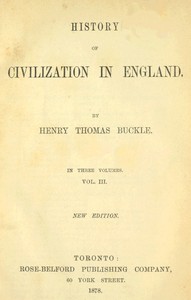
History of Civilization in England, Vol. 3 of 3 by Henry Thomas Buckle
Let's clear something up right away: you don't read Henry Thomas Buckle's History of Civilization for a straightforward timeline of English events. That's not what this is. Think of it instead as a grand, intellectual detective story. Buckle, a self-taught historian from the Victorian era, had a huge question: are there scientific laws that govern how societies rise, fall, and change, just like there are laws for physics?
The Story
This third volume continues Buckle's lifelong project. He dismisses the idea that history is just a series of accidents or the work of a few brilliant leaders. Instead, he digs into the underlying forces. He looks at how things we often ignore—like how much rain a country gets, the fertility of its soil, or even the average diet of its people—create the conditions for certain types of thought and government to flourish. He then applies this framework to specific case studies, like the history of Scotland and Spain, to show why their paths to modernization were so different. The 'plot' is his relentless argument, building evidence to support his radical thesis that our environment and the gradual accumulation of public knowledge are the true drivers of civilization.
Why You Should Read It
Reading Buckle today is a fascinating experience. You can feel his excitement. He was connecting dots between fields that no one else was talking about together. Is he always right? No. Some of his 19th-century ideas about race and nationality are uncomfortable and outdated. But that's partly why it's so compelling. You get to watch a powerful, original mind at work, wrestling with the biggest questions. It makes you think about the hidden structures in our own world. When you read about traffic patterns or social media algorithms, you're seeing a modern version of Buckle's quest for the rules behind human behavior.
Final Verdict
This book is not for someone looking for a simple narrative history. It's for the curious reader who loves big ideas. It's perfect for fans of writers like Steven Pinker or Jared Diamond, who tackle huge themes about society. It's also a must for anyone interested in the history of ideas itself—how people in the past tried to make sense of their world. Be prepared for dense passages and an unfinished argument, but if you stick with it, you'll be rewarded with a truly unique perspective. You're not just learning history from Buckle; you're learning how one man thought history worked.
This title is part of the public domain archive. Thank you for supporting open literature.
Mary Perez
4 months agoThe digital formatting makes it very easy to navigate.
Robert Hernandez
1 year agoThis work demonstrates a clear mastery of contemporary theories.
Ashley White
8 months agoRight from the opening paragraph, the clarity of the writing makes even the most dense sections readable. I'm glad I chose this over the other alternatives.
Barbara Lee
1 year agoFrom a researcher's perspective, the bibliography and references suggest a high level of research and authority. This adds significant depth to my understanding of the field.


Michael Lee
2 months agoI was skeptical about the depth of this book at first, but the evidence-based approach makes it a very credible source of information. Definitely a five-star contribution to the field.