About 114 minutes
The Voice and Spiritual Education — Context and Discussion
Educational Theory
26,161 recorded words. 4 minutes difference from this book's estimate.
View Gutenberg source #33175
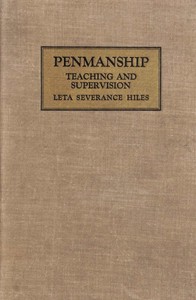
The source record for Penmanship: Teaching and Supervision — A Reader’s Guide measures this digital text at 26,943 words, 1 hr 58 min estimated reading time, and 16 detected text sections.
The text analysis averages about 19.8 words per sentence, while the detected sections provide another way to judge how the source is divided.
Project Gutenberg metadata also associates the work with “Penmanship,” connecting these edition facts with the source record’s subject description.
Explore this collection
These alternatives are selected using recorded categories and estimated reading time.
About 114 minutes
Educational Theory
26,161 recorded words. 4 minutes difference from this book's estimate.
View Gutenberg source #33175About 122 minutes
Educational Theory
27,967 recorded words. 4 minutes difference from this book's estimate.
View Gutenberg source #54814About 112 minutes
Educational Theory
25,741 recorded words. 6 minutes difference from this book's estimate.
View Gutenberg source #55509Search stored excerpts and compare books → Choose by your preferences →
Choices use stored catalog measurements. Estimates vary with reading speed. A shared category is a catalog label, not a claim that two books have the same argument or literary quality.
Search reads excerpt text stored with this catalog and links to its associated Gutenberg record. The connection is stored in the site database; this tool does not recheck that every excerpt is word-for-word identical to that external record. Excerpt search does not cover every chapter and does not verify historical publication dates.
Catalog snapshot checked: 2026-09-26. Coverage: 90 public books, 90 available source excerpts.
Calculated from edition completeness, EPUB availability, text structure and catalogue metadata. Not a user rating.
Total of 100 points, scaled to a 2.5-5.0 range. Editions with an empty description or a missing EPUB file are not scored.
Public-domain source text
The source text is kept in the dedicated reader, separate from this catalogue record and its commentary.
Leta Severance Hiles opens Penmanship: Teaching and Supervision with a blunt assessment: the mechanical side of writing is a neglected part of the educational fundamentals. Drawing on her experience as a supervisor in Long Beach, California, she treats penmanship not as an art but as a trainable motor skill, governed by posture, movement, and drill. The book’s voice is direct and prescriptive, favoring commands over explanations. A typical instruction reads: “Check each line for capitals into thirds, place four or five letters in a third; move paper to the left about two inches at each check mark, at the same time say aloud, ‘Move.’” This tone—brisk, repetitive, and teacher-facing—shapes the entire work.
Hiles structures her pedagogy around timed, counted exercises. In Chapter Six, she prescribes that students trace capitals twelve times, words six times, and sentences three times “at correct speed.” The count is not merely a pacing tool; it enforces uniformity. For ovals, she specifies “four hundred ovals” per line, with a verbal “Move” at each quarter. This language reveals a classroom where the teacher’s voice and the students’ choral responses create a rhythmic, almost industrial discipline. The emphasis on speed—half-minute, one-minute, two-minute drills—suggests that fluency is measured in strokes per interval, not in aesthetic quality. Hiles even includes a signal system: “Stand erect,” “Turn,” “Face,” “Down.” These commands reduce writing to a sequence of physical cues, stripping away ambiguity.
The book’s second chapter, “Fundamentals Concerned in the Problem,” lists “Correct Posture” and “Correct Movement” as prerequisites to letter formation. Hiles insists that the paper be slanted “so that the line written upon runs from corner to corner of the desk.” This spatial precision extends to the blackboard: pupils must “write as high as the eyes” and turn “the left side slightly toward the board.” The language is anatomical—she speaks of “even pressure” and “line quality” as results of correct speed, not of artistic flair. For Hiles, the body is a machine to be calibrated. She warns against poor materials with a construction metaphor: “In building any structure that we hope to last a lifetime we are careful to supply ourselves with the best of material. This principle applies in rearing the penmanship structure.” The analogy ties posture to durability, implying that sloppy habits produce weak foundations.
Throughout the manual, Hiles frames penmanship as a problem of resource management. She advises that “school boards and officials are generally willing to procure good supplies if economy is practiced in the use of them.” This fiscal awareness extends to time: the supervisor’s visit is a scheduled event, and teachers must prepare “samples” and “standard penmanship tests” in advance. The chapter “Suitable Equipment and Materials” discusses ink thickness, blotter use, and the dangers of adding water. Hiles even recommends that schools furnish all writing materials to ensure uniformity and “that every child may have an equal chance.” The supervisor’s role, as she defines it, is to audit these practices—to rate teachers, enforce drills, and maintain “the penmanship perspective.” The book’s final chapters on supervision describe it as a form of leadership, but the excerpts show a system built on checklists and counts, not inspiration.
Readers approaching Penmanship: Teaching and Supervision should expect a manual, not a philosophy. Hiles rarely speculates about why handwriting matters beyond commercial or educational utility; she focuses on how to produce it efficiently. The book’s value lies in its granular detail—the exact number of tracings, the angle of the paper, the timing of the “Move” command. For anyone studying early 20th-century classroom practice, these specifics offer a rare, unfiltered view of a subject now reduced to keyboarding. The voice is that of a supervisor who has seen too many crooked slants and is determined to straighten them, one drill at a time.
Answer a few questions and save a private reflection on this device.