About 237 minutes
A Garden of Girls; Or, Famous Schoolgirls of Former Days — Inside the Classic
Educational Theory
54,441 recorded words. 8 minutes difference from this book's estimate.
View Gutenberg source #63354
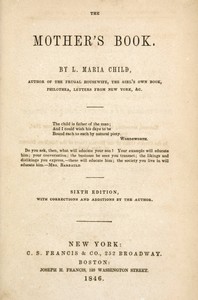
For The mother's book — Text and Context, the stored edition analysis reports 56,141 words, 4 hr 5 min estimated reading time, and 21 detected text sections.
The text analysis averages about 22.7 words per sentence, while the detected sections provide another way to judge how the source is divided.
Project Gutenberg metadata also associates the work with “Children -- Conduct of life,” connecting these edition facts with the source record’s subject description.
Explore this collection
These alternatives are selected using recorded categories and estimated reading time.
About 237 minutes
Educational Theory
54,441 recorded words. 8 minutes difference from this book's estimate.
View Gutenberg source #63354About 258 minutes
Educational Theory
59,145 recorded words. 13 minutes difference from this book's estimate.
View Gutenberg source #15595About 260 minutes
Educational Theory
59,687 recorded words. 15 minutes difference from this book's estimate.
View Gutenberg source #474Search stored excerpts and compare books → Choose by your preferences →
Choices use stored catalog measurements. Estimates vary with reading speed. A shared category is a catalog label, not a claim that two books have the same argument or literary quality.
Search reads excerpt text stored with this catalog and links to its associated Gutenberg record. The connection is stored in the site database; this tool does not recheck that every excerpt is word-for-word identical to that external record. Excerpt search does not cover every chapter and does not verify historical publication dates.
Catalog snapshot checked: 2026-09-26. Coverage: 90 public books, 90 available source excerpts.
Calculated from edition completeness, EPUB availability, text structure and catalogue metadata. Not a user rating.
Total of 100 points, scaled to a 2.5-5.0 range. Editions with an empty description or a missing EPUB file are not scored.
Public-domain source text
The source text is kept in the dedicated reader, separate from this catalogue record and its commentary.
Lydia Maria Child opens The Mother's Book with an epigraph from Wordsworth and a quotation from Mrs. Barbauld asserting that a parent's example, conversation, and daily business educate a child more than formal instruction. The book, first published in 1844 and appearing here in a sixth edition, is a practical manual grounded in the conviction that a mother's influence is paramount. Child does not offer a systematic theory but rather a series of observations and recommendations drawn from her own experience and reading. Her tone is direct and personal, often addressing the reader as 'you' and occasionally recalling her own childhood to illustrate a point. The excerpts reveal a writer who is both pragmatic and reflective, concerned with the formation of moral character through everyday interactions and the careful selection of reading material.
Child takes up the question of whether fairy tales and fables harm children. She dismisses the objection that such stories are not strictly true, arguing that children never believe them to be factual. Recalling her own childhood, she writes that she regarded them 'as efforts of the imagination—dreams that had a meaning.' She distinguishes between harmless tales like Cinderella and 'frightful and monstrous' stories, which she condemns. Fables, she contends, convey clear morals that children understand, provided adults explain them. Child even defends novels for young people on the grounds that forbidding what cannot be prevented is unwise; better to guide a child's choice than leave it to chance. This pragmatic approach reveals a nuanced view of imagination: she acknowledges its potential for mischief but insists it was 'bestowed upon us by the Great Giver' and deserves moderate cultivation.
A recurring theme is the mother's role as gatekeeper of reading. Child insists that children, especially girls between twelve and sixteen, should read nothing without a mother's knowledge and sanction. During this period, when feelings are 'fervent and enthusiastic' and understanding unstrengthened by experience, parents must provide 'plenty of innocent employment.' She also warns against stories about naughty children, which she believes 'suggest a thousand little tricks and deceptions.' She cites a specific work—Adelaide, or Stories for Children by a Lady of Philadelphia—as an example of a well-intentioned book that nevertheless carries this risk. The emphasis is on prevention rather than cure: 'It is better to paint virtue to be imitated, than vice to be shunned.' Familiarity with evil, even when presented as disgusting, is a disadvantage.
Child's central pedagogical principle is that education happens through lived example. She quotes Mrs. Barbauld: 'Your example will educate him; your conversation; the business he sees you transact; the likings and dislikings you express.' This conviction shapes her advice throughout the excerpts. She does not prescribe a curriculum but rather a mode of attentive presence. The mother's own character, her daily choices, and the atmosphere of the home are the primary instruments of moral formation. Child's voice is that of an experienced advisor who trusts the reader's judgment while offering pointed guidance. She avoids abstract theorizing, instead grounding her recommendations in concrete situations—what to read, what to avoid, how to explain a moral. The book is less a treatise than a companion for the conscientious mother.
Readers approaching The Mother's Book will find a work that is both of its time and surprisingly direct in its practical counsel. Child's willingness to defend fairy tales while cautioning against stories of naughty children reveals a thinker who balances moral seriousness with a respect for a child's imaginative life. The book rewards attention to its specific examples and the reasoning behind them, rather than a search for universal rules. It is best read as a conversation with a thoughtful, opinionated guide.
Reading Child’s gentle insistence on a mother’s watchful presence, I found myself thinking of someone who carried that same quiet duty into the schoolroom. Her belief that character grows through example, not lectures, echoed in my mind. Then I remembered Frances Mary Buss and her work for education — Text and Context, and how that pioneering spirit felt like a different kind of maternal care, extended to strangers’ daughters.
Answer a few questions and save a private reflection on this device.