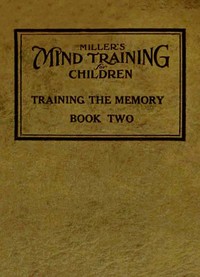
Miller's Mind training for children Book 2 (of 3) A practical training for successful living; Educational games that train the senses — Edition Insights

(0 User reviews)   708
In Category - Educational Theory
Miller, William Emer Project Gutenberg 2017 Not confirmed
Mnemonics; Senses and sensation Readers of public-domain and historical texts
Project Gutenberg digital edition en

Edition facts

Words 29,486
Reading time 129 min
Text sections 8

For Miller's Mind training for children Book 2 (of 3) A practical training for successful living; Educational games that train the senses — Edition Insights, the stored edition analysis reports 29,486 words, 2 hr 9 min estimated reading time, and 8 detected text sections.

The text analysis averages about 19.2 words per sentence, while the detected sections provide another way to judge how the source is divided.

Project Gutenberg metadata also associates the work with “Mnemonics,” connecting these edition facts with the source record’s subject description.

Explore this collection

Compare your next read

These alternatives are selected using recorded categories and estimated reading time.

Search stored excerpts and compare books → Choose by your preferences →

How these choices and excerpts are prepared

Choices use stored catalog measurements. Estimates vary with reading speed. A shared category is a catalog label, not a claim that two books have the same argument or literary quality.

Search reads excerpt text stored with this catalog and links to its associated Gutenberg record. The connection is stored in the site database; this tool does not recheck that every excerpt is word-for-word identical to that external record. Excerpt search does not cover every chapter and does not verify historical publication dates.

Catalog snapshot checked: 2026-09-26. Coverage: 90 public books, 90 available source excerpts.

William E. Miller's 1921 manual presents a sound-based number-code system for memory training, emphasizing visual association and mnemonic games. This second book in a three-volume series focuses on practical exercises for children, with detailed instructions on forming mental pictures and using 'hitching posts' to recall abstract information.
Share
Editorial Edition Score 4.7/5

Calculated from edition completeness, EPUB availability, text structure and catalogue metadata. Not a user rating.

How this score is calculated
  • Description quality20 pts
  • Title & short description10 pts
  • Source metadata20 pts
  • Text length15 pts
  • Chapters / structure15 pts
  • EPUB file integrity20 pts

Total of 100 points, scaled to a 2.5-5.0 range. Editions with an empty description or a missing EPUB file are not scored.

Edition quality

Public-domain source text

Read the source text

The source text is kept in the dedicated reader, separate from this catalogue record and its commentary.

William E. Miller's Mind Training for Children, Book 2 (1921) opens with a direct claim: 'The memory is the most used of all the faculties.' From this premise, the book builds a systematic method for improving recall through sensory training, particularly sight. Miller insists that 'the strongest sense is sight' and that 'visual impressions [are] most accurate,' anchoring his technique in the creation of vivid mental pictures. The text is less a theoretical treatise than a practical workbook, filled with exercises, code tables, and games designed for children and their instructors.

Sound as the Basis of a Number Code

Miller devotes considerable space to a phonetic number code, where each digit from 0 to 9 is assigned a consonant sound based on articulation. For example, 'D and T are similar in sound and therefore either can be used to represent the digit 1.' The code is built entirely on sound, not spelling: 'Silent letters have no figure value, because they are not SOUNDED.' This rule leads to surprising transformations—'NIGHT is 21 for the GH is silent'—and forces the reader to listen to words rather than read them. Miller extends the code by allowing similar sounds (soft G for 6, SH for 6, hard C for 7) and even introduces an arbitrary suffix, 'ING,' to represent 7, as in '447 RoaRING.' The result is a flexible but demanding system that requires the user to internalize a new phonetic alphabet.

Visualization and the 'Hitching Post' Method

Beyond the number code, Miller promotes a technique he calls 'alphabetical hitching posts'—a set of predetermined mental images for numbers 1 to 100. These images serve as anchors for forming associations: 'as soon as any number of two digits was mentioned a word-picture of this value would come into your mind.' The method relies on exaggeration, motion, and unusual associations to make images memorable. Miller advises the reader to 'sharpen the tools' by practicing with lists and games like 'The Game of Code' and 'The Game of Solitaire.' The emphasis is on active, repeated drilling rather than passive learning. The book provides sample exercises, such as translating numbers into words (e.g., '38 M F MuFf'), and encourages the reader to create their own.

Pacing and the Role of Repetition

Miller's instructional voice is direct and repetitive, mirroring the method he advocates. He frequently restates core principles—'The important thing to keep in mind in the use of this Code is the fact that all is based upon SOUND'—and includes review tests and practice lists. The book's structure alternates between explanation and exercise, with sections like 'Forming Larger Number Words' and 'Adjective as Helps' building incrementally. The pace is deliberate, designed for step-by-step mastery. Miller warns against procrastination ('Beware of Procrastination') and insists that 'review is essential' and 'methodical review best.' This pedagogical rhythm, while sometimes repetitive, reflects a belief that memory training requires consistent, effortful practice.

Readers should approach this book as a manual to be used, not merely read. The exercises—especially the number-code drills and hitching-post games—demand active participation. Miller's method is rooted in early 20th-century educational theory, but its focus on sound-based mnemonics and visual association remains relevant. For best results, work through the exercises in order, and consider adapting the games for group or classroom use. The book's value lies in its practical, hands-on approach to training the memory.

Lately I’ve been turning the pages of Miller's Mind Training for Children, savoring its quiet insistence on hitching each memory to a picture. It made me think of an old schoolroom, and of someone who believed children’s minds deserved such gentle craft. That thought led me to Frances Mary Buss and her work for education — Text and Context, a book that feels like the same earnest hope, only clothed in brick and mortar.

There are no reviews for this eBook.

0
0 out of 5 (0 User reviews )

Add a Review

Your Rating *
There are no comments for this eBook.

Reader reflection

How did this book work for you?

Your answers remain private and are stored only in this browser.

Your progress 0 / 10
1

Where are you in your reading?

2

What was your overall reaction to the book?

3

Would you recommend this book to another reader?

4

What was the reading difficulty like?

Related eBooks