About 173 minutes
Life in the Medieval University — A Reader’s Guide
Educational Theory
39,720 recorded words. 19 minutes difference from this book's estimate.
View Gutenberg source #20958
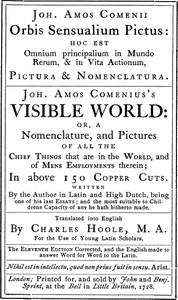
This digital edition of The Orbis Pictus — Edition Insights is described by source-level measurements including 35,335 words, 2 hr 34 min estimated reading time, and 11 detected text sections.
The text analysis averages about 6.9 words per sentence, while the detected sections provide another way to judge how the source is divided.
Project Gutenberg metadata also associates the work with “Natural history -- Juvenile literature,” connecting these edition facts with the source record’s subject description.
Explore this collection
These alternatives are selected using recorded categories and estimated reading time.
About 173 minutes
Educational Theory
39,720 recorded words. 19 minutes difference from this book's estimate.
View Gutenberg source #20958About 129 minutes
Educational Theory
29,486 recorded words. 25 minutes difference from this book's estimate.
View Gutenberg source #55508About 122 minutes
Educational Theory
27,967 recorded words. 32 minutes difference from this book's estimate.
View Gutenberg source #54814Search stored excerpts and compare books → Choose by your preferences →
Choices use stored catalog measurements. Estimates vary with reading speed. A shared category is a catalog label, not a claim that two books have the same argument or literary quality.
Search reads excerpt text stored with this catalog and links to its associated Gutenberg record. The connection is stored in the site database; this tool does not recheck that every excerpt is word-for-word identical to that external record. Excerpt search does not cover every chapter and does not verify historical publication dates.
Catalog snapshot checked: 2026-09-26. Coverage: 90 public books, 90 available source excerpts.
Calculated from edition completeness, EPUB availability, text structure and catalogue metadata. Not a user rating.
Total of 100 points, scaled to a 2.5-5.0 range. Editions with an empty description or a missing EPUB file are not scored.
Public-domain source text
The source text is kept in the dedicated reader, separate from this catalogue record and its commentary.
The Orbis Pictus presents each subject as a numbered illustration with parallel Latin and English captions, a method that trains the eye and ear simultaneously. The barber shop scene, for instance, itemizes tools—sizzars, razor, bason, laver, sope, towel, comb, crisping iron—each keyed to a number in the picture. This systematic labeling turns a mundane activity into a structured vocabulary lesson.
The work’s editorial history is layered: Charles Hoole’s 1659 translation, C. W. Bardeen’s 1887 edition, and the Project Gutenberg transcription all intervene, yet the core pedagogical design remains visible. The stable section similarly enumerates actions: cleaning, tying, winnowing oats, watering, rubbing, combing, inspecting shoes. Such sequences reveal Comenius’s belief that language learning should mirror the order of real-world tasks.
Across the excerpts, numbering governs both text and image. In the barber shop (LXXVI), each object and action receives a numeral: Tonsor (1), Forcipe (3), Novaculâ (4), Pelvim (5). The stable (LXXVII) follows suit: Stabularius (1), Capistro (4), Præsepe (5). This system forces the reader to associate each Latin word with a specific visual referent, not a translation equivalent. The dials chapter (LXXVIII) extends the method to abstract concepts: a sun-dial (1), hour-glass (4), clock (5), each with numbered parts like Gnomon (2) and Pondus (6). Comenius thus treats timekeeping as a set of tangible components, making the invisible measurable through enumeration.
The facing-page layout places Latin on the left, English on the right, with identical numbering. In the barber shop, the Latin “Tonsor … tondet Crines & Barbam Forcipe” runs parallel to “The Barber … cutteth off the Hair and the Beard with a pair of Sizzars.” The English often expands or clarifies: “Lixivio defluente è Gulturnio” becomes “Suds running out of a Laver,” adding the word “Suds” not present in the Latin. This asymmetry suggests the English version was designed for beginners, while the Latin offers a more compact, classical phrasing. The stable passage shows similar divergence: “Ventilat Avenam, Vanno” is rendered “He winnoweth Oats with a Van,” with the parenthetical “being mixt with Chaff” inserted only in English. Such additions hint at Hoole’s pedagogical adjustments for his audience.
Several scenes center on the human body as a site of work and care. The barber shop involves cutting hair, shaving, washing, combing, and even bloodletting: “Sometimes he cutteth a Vein with a Pen-knife, where the Blood spirteth out.” The stable focuses on the horse’s body—cleaning dung, rubbing with a cloth, combing with a curry-comb, inspecting hoofs and shoes. The dials chapter, though about time, still uses a human-scale metaphor: the clock’s hand “by its motion about sheweth the hour.” This bodily grounding reflects Comenius’s principle that learning should start with the senses. The picture (LXXIX) explicitly states: “Pictures delight the Eyes and adorn Rooms,” and the painter’s tools—pencil, table, case-frame, pollet, marble—are again numbered. The body, whether human or animal, serves as the primary reference point for understanding the world.
Readers should approach the Orbis Pictus as a historical artifact of sensory learning, not a modern storybook. Pay attention to what is included (tools, actions, body parts) and what is omitted (narrative, dialogue, emotion). The numbered system rewards slow, comparative reading: cover the English side and try to deduce meaning from the Latin and the picture alone. Notice how the 1887 editor’s preface and the Project Gutenberg transcription notes frame the text—these paratexts reveal how each era reinterprets Comenius’s method.
Opening The Orbis Pictus, I remembered sitting on my mother’s lap, pointing at numbered pictures in an old reader. The world felt orderly then—each object named, each scene numbered. That same quiet calm returned with The Ontario Readers: Third Book — Context and Discussion, where lessons felt like small discoveries rather than tasks. Both books held a gentleness, a patience for a child’s pace.
Build a private reading journal entry for this title.