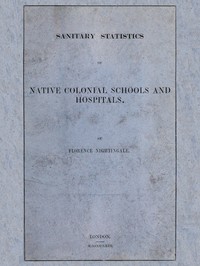
Florence Nightingale opens this 1863 report with a striking paradox: 'I answer, That is why I wrote it, because there is nothing in it, in order that something might come out of nothing.' She immediately establishes that the colonial statistics she has compiled are insufficient for drawing firm conclusions. The work originated from a conversation with Sir George Grey about the 'gradual disappearance of the aboriginal races' near European settlements, prompting Nightingale to investigate whether school usages affected native children's health. The Colonial Office distributed her printed forms, but returns came from only 143 schools, with many colonies failing to provide data.
A Data Vacuum in the Colonies
Nightingale's central frustration is that the colonial returns 'are incapable of giving all the beneficial information expected.' She notes that the material 'does not exist, or, if it does, it is in a very undeveloped state.' The tables she presents—covering schools in Ceylon, Australia, Natal, West Africa, and British North America—are based on incomplete submissions. For instance, she received no information from many more schools, presuming their statistics 'did not afford the means of supplying the required information.' This candid admission frames the entire work as a methodological critique rather than a definitive study.
Mortality Tables: A Window into Colonial Hospitals
The hospital returns from Freetown, Sierra Leone, illustrate the kind of data Nightingale managed to collect. Table L, Part 1, shows admissions and deaths by age and sex for diseases such as variola, dysentery, and periodic fevers. For all diseases, 20.3% of males and 18.6% of females died in hospital. Notably, children under five had 100% mortality for variola and dysentery in some categories, though the note warns that 'where the proportion of deaths or recoveries approach 100 per cent. the observations have been very few.' Nightingale meticulously calculates proportions per cent, but the small sample sizes undermine reliability.
The Challenge of Incomplete Returns
Throughout the tables, Nightingale inserts cautionary notes. In Table L, Part 2, she explains that 'in some instances the number of admissions were exceeded by the deaths + the recoveries,' forcing her to treat the aggregate of deaths and recoveries as the number of admissions. This statistical workaround highlights the poor record-keeping in colonial hospitals. Similarly, Table M shows the proportion of deaths from each cause, but the note repeats that 'the deaths + recoveries have been taken as the admissions.' These adjustments reveal the fragility of the data Nightingale had to work with.
A Blueprint for Better Data Collection
Despite the shortcomings, Nightingale's report serves as a template for systematic health statistics. She includes detailed tables for each colony, with columns for age groups, diseases, and outcomes. The school returns (Table A) record the name, opening date, years included, average number of children by sex and age for quinquennial periods, and mortality. By publishing these incomplete results, Nightingale demonstrates what data should be collected and how it should be presented. Her work is less a finished analysis than a call for standardized, comprehensive reporting across the empire.
Readers should approach this text as a primary source on the history of statistics and colonial administration. Nightingale's candid admissions of data limitations make the work more valuable, not less: it documents the practical obstacles to evidence-based policy in the 1860s. The tables reward careful study, but the accompanying prose—especially the opening paradox—reveals Nightingale's sharp awareness of her project's provisional nature.
Leafing through Nightingale’s colonial mortality tables, I kept noticing the quiet gaps—what nobody had thought to record. That same absence lingered while re-reading Printing and bookbinding for schools — Text and Context, where the physical making of books mirrors what data conceals. Both feel like unfinished ledgers, half-remembered hands, margins left blank for someone else’s patient curiosity.