About 179 minutes
Elements of Debating: A Manual for Use in High Schools and Academies — Background and Themes
Schools Learning
41,145 recorded words. 0 minutes difference from this book's estimate.
View Gutenberg source #14090
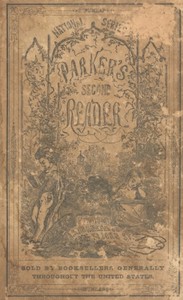
Parker's Second Reader National Series of Selections for Reading, Designed For The Younger Classes In Schools, Academies, &C. — Reading Companion can be approached with a clearer sense of reading commitment from its source measurements: 41,037 words, 2 hr 59 min estimated reading time, and 7 detected text sections.
The text analysis averages about 22.9 words per sentence, while the detected sections provide another way to judge how the source is divided.
Project Gutenberg metadata also associates the work with “Readers (Elementary),” connecting these edition facts with the source record’s subject description.
Explore this collection
These alternatives are selected using recorded categories and estimated reading time.
About 179 minutes
Schools Learning
41,145 recorded words. 0 minutes difference from this book's estimate.
View Gutenberg source #14090About 173 minutes
Schools Learning
39,673 recorded words. 6 minutes difference from this book's estimate.
View Gutenberg source #35050About 169 minutes
Schools Learning
38,663 recorded words. 10 minutes difference from this book's estimate.
View Gutenberg source #48702Search stored excerpts and compare books → Choose by your preferences →
Choices use stored catalog measurements. Estimates vary with reading speed. A shared category is a catalog label, not a claim that two books have the same argument or literary quality.
Search reads excerpt text stored with this catalog and links to its associated Gutenberg record. The connection is stored in the site database; this tool does not recheck that every excerpt is word-for-word identical to that external record. Excerpt search does not cover every chapter and does not verify historical publication dates.
Catalog snapshot checked: 2026-09-26. Coverage: 90 public books, 90 available source excerpts.
Calculated from edition completeness, EPUB availability, text structure and catalogue metadata. Not a user rating.
Total of 100 points, scaled to a 2.5-5.0 range. Editions with an empty description or a missing EPUB file are not scored.
Public-domain source text
The source text is kept in the dedicated reader, separate from this catalogue record and its commentary.
Richard Green Parker's 1851 reader opens with a preface that explicitly frames the book's pedagogical philosophy: words are 'but sounds, by which ideas should be conveyed,' and the teacher's hand should assist, not lift. This emphasis on active understanding rather than passive recitation sets the stage for the selections that follow. The excerpts reveal a deliberate pattern: lessons alternate between cautionary narratives about heedless children—like Anna, who repeatedly fails to complete her tasks—and factual pieces on natural history or poetry. The moral tales are structured around a clear contrast between intention and execution, with the child's good intentions repeatedly undone by distraction and poor planning.
The excerpts from Lessons XXIX and XXX illustrate a recurring narrative formula. Anna resolves to 'make amends for past neglect' but is immediately sidetracked: she forgets where she left the watering-pot, waters plants in full sun despite her mother's caution, and then plays with her bird until 'the best part of the morning' is gone. The pattern is repeated in the following lesson, where a friend's toy ship leads to another failure. Each episode follows a sequence: a resolution, a distraction, a consequence, and a moment of chagrin. The moral is not delivered by a narrator but through the child's own 'heavy heart' and the servant Betty's pointed 'I told you so.' This structure suggests that Parker expected the young reader to infer the lesson from the consequences shown, rather than from explicit preaching.
Physical objects in the excerpts serve as both temptations and tools for learning. The watering-pot, the birdcage, the doll's house, and the toy ship each trigger a chain of actions that reveal the child's character. The ship, in particular, is described with precise detail—'graceful form, its delicate rigging and snowy sails'—and its sinking is rendered with equal care: 'the weight of the stones carried it straight to the bottom.' The setting also reinforces the moral geography: the garden, the brook, and the cottage of the poor Wilson children are places where Anna's failures occur. The duck-pond, where the children's new frocks are again dirty, becomes a symbol of the futility of superficial reform. Parker uses these concrete details to ground abstract virtues like diligence and foresight in observable, physical outcomes.
Throughout the excerpts, adult figures—the mother, the servant Betty, the absent father—are sources of rules and wisdom, but they are rarely present during the child's trials. Anna's mother is mentioned only through her caution about watering plants; Betty appears only to deliver reproof. The child is left to act alone, and her failures stem from her own inability to sustain attention. Parker's preface insists that the pupil 'must perform the march himself,' and the narratives dramatize this principle: the teacher (or parent) provides guidance, but the child must learn through experience. The tension is between the adult's desire for orderly progress and the child's natural impulsiveness. Anna's repeated failures are not punished by adults but by the natural consequences of her actions—the ship sinks, the plants wilt, the poor children's frocks get dirty again. This pedagogical strategy aligns with Parker's stated aim to 'lighten' real difficulties while leaving 'some labor' for the scholar.
Readers approaching this volume should attend to the interplay between the moral tales and the non-fiction selections that surround them. The excerpts suggest that Parker intended the reader to move between narrative empathy and factual observation, building both character and knowledge. The preface's emphasis on understanding over mere oral performance invites the teacher to use these texts as springboards for discussion, not just recitation drills.
I have often thought, holding that old Parker's Second Reader, how its lessons on steady diligence echo in those later ledgers of colonial schools. Both whisper of children trying to balance a restless heart against a grown world's careful rules. The kinship is quiet, like a shared sigh—one I found again in Sanitary Statistics of Native Colonial Schools and Hospitals — Reading Companion, where numbers, too, carry a tenderness for small, striving lives.
Your answers remain private and are stored only in this browser.