About 179 minutes
Elements of Debating: A Manual for Use in High Schools and Academies — Background and Themes
Schools Learning
41,145 recorded words. 50 minutes difference from this book's estimate.
View Gutenberg source #14090
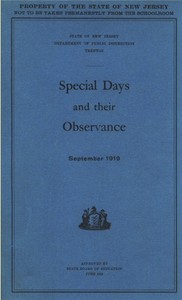
The catalog record for Special Days and Their Observance September 1919 — Context and Discussion provides practical reading context through 52,547 words, 3 hr 49 min estimated reading time, and 8 detected text sections.
The text analysis averages about 19.6 words per sentence, while the detected sections provide another way to judge how the source is divided.
Project Gutenberg metadata also associates the work with “Schools -- Exercises and recreations -- New Jersey,” connecting these edition facts with the source record’s subject description.
Explore this collection
These alternatives are selected using recorded categories and estimated reading time.
About 179 minutes
Schools Learning
41,145 recorded words. 50 minutes difference from this book's estimate.
View Gutenberg source #14090About 179 minutes
Schools Learning
41,037 recorded words. 50 minutes difference from this book's estimate.
View Gutenberg source #16936About 173 minutes
Schools Learning
39,673 recorded words. 56 minutes difference from this book's estimate.
View Gutenberg source #35050Search stored excerpts and compare books → Choose by your preferences →
Choices use stored catalog measurements. Estimates vary with reading speed. A shared category is a catalog label, not a claim that two books have the same argument or literary quality.
Search reads excerpt text stored with this catalog and links to its associated Gutenberg record. The connection is stored in the site database; this tool does not recheck that every excerpt is word-for-word identical to that external record. Excerpt search does not cover every chapter and does not verify historical publication dates.
Catalog snapshot checked: 2026-09-26. Coverage: 90 public books, 90 available source excerpts.
Calculated from edition completeness, EPUB availability, text structure and catalogue metadata. Not a user rating.
Total of 100 points, scaled to a 2.5-5.0 range. Editions with an empty description or a missing EPUB file are not scored.
Public-domain source text
The source text is kept in the dedicated reader, separate from this catalogue record and its commentary.
This 1919 manual, issued by the New Jersey Department of Public Instruction, prescribes how schools should observe patriotic holidays. The text opens with a stark legal notice—'Property of the State of New Jersey Not to Be Taken Permanently from the Schoolroom'—framing the book as a state instrument. Its foreword reproduces statutes requiring 'appropriate exercises for the development of a higher spirit of patriotism,' establishing a tone of official duty. The contents list reveals a collaborative authorship: individual chapters are credited to educators like J. Cayce Morrison and Charles A. Philhower, each responsible for a specific holiday. The language throughout is prescriptive and ceremonial, blending legal mandates with poems, speeches, and historical anecdotes.
The manual's opening pages foreground state authority. The foreword quotes New Jersey statutes verbatim, mandating observances for Arbor Day, Lincoln's Birthday, Washington's Birthday, Memorial Day, Thanksgiving, and Flag Day. This legal language—'shall be suitably observed,' 'it shall be the duty'—establishes a bureaucratic voice that contrasts with the more lyrical passages later. The authorial choice to begin with law rather than pedagogy signals that the book is an official curriculum, not a suggestion. The repeated phrase 'appropriate exercises' becomes a refrain, emphasizing uniformity over creativity. This tension between legal prescription and educational inspiration shapes the entire work.
The excerpts about Washington illustrate a deliberate diction of reverence. Phrases like 'No nobler figure ever stood in the forefront of a nation's life' and 'the man first in war, first in peace, and first in the hearts of his fellow countrymen' employ elevated, almost biblical language. The text uses 'solemn awe' and 'naked, deathless splendor' to describe Washington's name, creating a tone of hagiography. The anecdote of Washington helping soldiers—'lent a helping hand, perspiring freely'—uses concrete, physical detail to humanize the hero while maintaining his iconic status. This blend of the mundane and the majestic is a consistent authorial strategy: the corporal's pompous reply 'Don't you know I'm the corporal?' is deflated by Washington's quiet retort, reinforcing humility as a civic virtue.
The manual's structure itself enforces a ritualistic pattern. Each holiday chapter likely follows a similar template: a historical overview, a poem or speech, and suggested exercises. The table of contents lists contributors, but the excerpts show that the prose often shifts between third-person historical narrative and direct address. For instance, the Washington section includes a long passage from J. R. Green's history, then a poem, then a biographical sketch. This collage of voices—legal, historical, poetic—creates a layered authority. The repetition of key phrases like 'first in war, first in peace' across different sections reinforces the didactic purpose: students are meant to internalize these phrases through repeated exposure. The authorial choice to include multiple versions of the same story (e.g., the sailor anecdote) suggests that variety within uniformity was intentional.
The setting is never described, but it is implied by the book's physical inscription: 'Property of the State of New Jersey Not to Be Taken Permanently from the Schoolroom.' This notice, repeated on the title page, anchors the text in a specific institutional space. The exercises are designed for a collective, teacher-led performance. The language assumes a classroom with a blackboard, a flag, and students who recite in unison. The inclusion of poems like 'Washington' by an unnamed author suggests that the book was meant to be read aloud. The manual's reliance on printed speeches and historical excerpts indicates that teachers were expected to read from the book, not improvise. This fixed, scripted quality reflects the authorial choice to minimize variation and maximize control over the patriotic message.
Readers approaching this manual should attend to its dual nature: it is both a historical artifact and a pedagogical tool. The authorial choices—the legal framing, the reverent diction, the repetitive structure, the implied classroom setting—reveal a deliberate effort to shape young citizens through ritualized language. The book offers a window into early 20th-century American civic education, where patriotism was taught through prescribed words and exemplary figures. Its value lies not in literary merit but in its precise reflection of a state's attempt to standardize national feeling.
I remember the September manual’s solemn hush around Washington’s birthday, how it taught children to stand straight and speak of duty. That old Parker's Second Reader National Series of Selections for Reading, Designed For The Younger Classes In Schools, Academies, &C. — Reading Companion whispered the same quiet lessons beside me—both trusted small voices to carry big feelings, gently, over years of desks and dust.
A brief reflection can help important ideas stay with you longer.