The Polkinghornes' manual moves from paper and match-box toys for infants to mechanical models requiring soldering and fret-saw work, a progression that mirrors both the child's growing skill and the historical development of toys. The authors repeatedly emphasize the importance of precise measurement and the reuse of household items, such as match-boxes, corks, and knitting needles, as structural components. This practical economy is paired with a clear visual imagination: each toy is described with specific dimensions and assembly steps, often accompanied by diagrams referenced in the text.
From Simple to Complex: The Book's Structure
The work is divided into two parts: Part I covers paper and cardboard toys for younger children, while Part II introduces woodwork, mechanical toys, and more advanced tools. This division is not merely a matter of difficulty; it reflects a pedagogical principle. The authors state that toy-making has "educational possibilities," and the sequence of projects—from paper folding to constructing a windmill with a rotating cap—embodies a gradual introduction to materials and techniques. The early chapters use only paper, scissors, and paste; later ones require stripwood, fret-saws, and soldering irons. The reader is never asked to attempt a skill before its prerequisite has been practiced.
Recurring Images: Wheels, Sails, and Movement
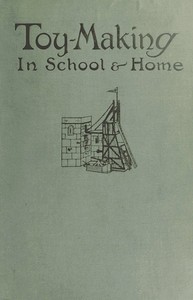
Throughout the manual, certain mechanical elements reappear: wheels, sails, and rotating parts. The windmill project (Chapter VI of Part II) is a culmination of these motifs. The authors describe how to make sails from cardboard, attach them to a knitting needle, and mount the mill on a stand so it can "be turned round in any direction so that the sails may catch the wind." This concern with actual movement—not just static models—is evident in earlier projects like the merry-go-round and the swinging boats. The text frequently specifies how to ensure parts move freely, such as using a cork washer to prevent the sails from touching the windmill walls.
Materials as Characters: Match-boxes, Corks, and Reels
The authors treat everyday objects as building blocks. Match-boxes become the chassis of toy vehicles; corks are carved into animals; wooden reels serve as stands. In the windmill instructions, a reel is used as a base: "glue a piece of round rod into the reel ... so that it projects about an inch." This resourcefulness is a recurring theme. The book does not assume access to a well-stocked workshop; instead, it shows how to repurpose household discards. The instructions for a crane (Chapter V of Part II) similarly rely on stripwood and cardboard, with a cotton reel for the winding mechanism.
Movement Between Scenes: From Classroom to Home
The title itself signals a dual setting: "School and Home." The prefatory note thanks the headmistress of the County Secondary School, Streatham, indicating the book's origin in educational practice. Yet the projects are designed to be made at home with common tools. The text frequently addresses the reader directly, offering alternatives when specific materials are unavailable: "If a needle cannot be obtained, an old bicycle spoke, or even a wooden meat skewer, will do." This flexibility suggests the authors anticipated a wide range of settings, from a well-equipped school handicraft room to a kitchen table. The book thus bridges institutional and domestic spaces, making toy-making accessible to both teachers and parents.
Readers approaching this manual should note that the authors assume no prior knowledge of woodworking or mechanics. Each step is explained with precise measurements and clear sequences, though the text occasionally refers to diagrams that are not included in this digital edition. The book is best used as a practical guide: choose a project that matches available materials and skill level, and follow the instructions in order. The progression from paper to wood is deliberate, and skipping ahead may require tools or techniques not yet introduced.
What stayed with me wasn't the clever paper folds or the little wooden wheels, but how the book treats making as a quiet kind of thinking—materials teaching hands, then hands teaching minds. It reminded me of The dramatic instinct in children — Reading Companion, which lingers the same way, watching how a child's play builds its own honest logic. I kept turning pages slowly, just to feel that.