About 114 minutes
Discipline in School and Cloister — Key Ideas to Explore
Teaching Methods
26,148 recorded words. 9 minutes difference from this book's estimate.
View Gutenberg source #65264
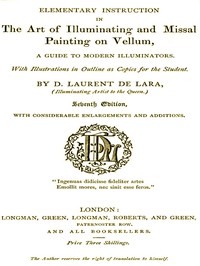
The catalog record for Elementary Instruction in the Art of Illuminating and Missal Painting on Vellum A Guide to Modern Illuminators — Text and Context provides practical reading context through 24,017 words, 1 hr 45 min estimated reading time, and 4 detected text sections.
The text analysis averages about 21.8 words per sentence, while the detected sections provide another way to judge how the source is divided.
Project Gutenberg metadata also associates the work with “Illumination of books and manuscripts,” connecting these edition facts with the source record’s subject description.
Explore this collection
These alternatives are selected using recorded categories and estimated reading time.
About 114 minutes
Teaching Methods
26,148 recorded words. 9 minutes difference from this book's estimate.
View Gutenberg source #65264About 116 minutes
Teaching Methods
26,547 recorded words. 11 minutes difference from this book's estimate.
View Gutenberg source #45410About 141 minutes
Teaching Methods
32,388 recorded words. 36 minutes difference from this book's estimate.
View Gutenberg source #59238Search stored excerpts and compare books → Choose by your preferences →
Choices use stored catalog measurements. Estimates vary with reading speed. A shared category is a catalog label, not a claim that two books have the same argument or literary quality.
Search reads excerpt text stored with this catalog and links to its associated Gutenberg record. The connection is stored in the site database; this tool does not recheck that every excerpt is word-for-word identical to that external record. Excerpt search does not cover every chapter and does not verify historical publication dates.
Catalog snapshot checked: 2026-09-26. Coverage: 90 public books, 90 available source excerpts.
Calculated from edition completeness, EPUB availability, text structure and catalogue metadata. Not a user rating.
Total of 100 points, scaled to a 2.5-5.0 range. Editions with an empty description or a missing EPUB file are not scored.
Public-domain source text
The source text is kept in the dedicated reader, separate from this catalogue record and its commentary.
Laurent de Lara opens his manual not with a philosophical preamble but with a blunt list of tools and materials: brushes, gesso, gold leaf, and vellum. The book, published in the mid-19th century, is a practical handbook for the revival of medieval illumination, aimed at students who wish to learn the craft from scratch. De Lara, who identifies himself as a teacher, writes in the first person and frequently addresses the reader as “the pupil,” creating a sense of direct apprenticeship. The text is dense with specific instructions—how to mix enamel white, how to apply raised gilding, how to breathe on gold leaf to make it adhere. There is no romanticizing of the art; instead, the focus is on repeatable steps and the avoidance of common errors.
De Lara’s prose is that of a working instructor. He uses the imperative mood throughout: “dip the brush,” “rub it over,” “leave it there for about one hour.” The reader is assumed to be a beginner, but not a passive one. The author insists on personal demonstration for the most advanced techniques, noting that one method “can only be communicated to my pupils personally, as it is a process that cannot possibly be imparted in any other manner than by personal superintendence.” This admission marks a boundary of the printed text: the book can teach the basics, but mastery requires a living teacher. The manual thus positions itself as a supplement to, not a replacement for, direct instruction.
The manual devotes considerable space to the preparation and use of materials. De Lara describes two methods for raised gilding: one using “Enamel White” and another using his own “Liquid Gold Cement,” which he claims is “more expeditious and less troublesome.” He gives precise timings—ten to fifteen minutes for the paste to set, one hour for the gold to harden—and warns that imperfections will diminish as the pupil gains experience. The emphasis on material behavior (breathing on gold leaf to make it adhere, using a “crooked agate” for burnishing) reflects a craft knowledge that is tactile and empirical. The reader is repeatedly told to test and adjust, not merely to follow recipes.
In his conclusion, de Lara urges the student to study original medieval manuscripts, specifically those at the British Museum, the libraries of Oxford and Cambridge, and, if possible, the Vatican and the Royal Library at Paris. He states that “no other than the very originals ought to be consulted” and describes accompanying his pupils to the manuscript rooms “half-a-dozen times” to point out essential details. This recommendation grounds the manual in a specific historical context: the 19th-century revival of illumination relied on access to institutional collections. De Lara does not provide reproductions of complete works; his illustrations are “merely explanatory.” The student is expected to move from the book to the archive.
De Lara is candid about what his book cannot do. He acknowledges that the most advanced gilding technique “cannot possibly be imparted in any other manner than by personal superintendence and demonstration.” The manual is structured as a series of progressive steps, but it ends with an invitation to seek further instruction. The final pages list other illuminated works published by Longman, Green & Co., including titles by Henry Noel Humphreys and F. Lepelle de Bois-Gallais, situating de Lara’s book within a commercial and pedagogical network. The reader is left with a clear sense that the manual is a starting point, not a complete education.
De Lara’s manual is best read as a period document of craft pedagogy. Its value lies not in its originality—many techniques were centuries old—but in its detailed, step-by-step recording of a process that was being revived for a new generation of practitioners. Readers interested in the history of book arts or in practical reconstruction of medieval techniques will find the most use in the sections on gilding and material preparation. The book assumes access to specialized supplies and a teacher for advanced work; it does not pretend to be a standalone course.
I keep thinking about how Laurent de Lara insisted on learning by touching the actual vellum, not just reading about it—there's a quiet trust in the hand. That same patient, step-by-step attention to structure and form lives in German composition — Key Ideas to Explore, almost like a gentle echo. Both ask you to slow down and notice the bones of a craft.
Save your reaction, strongest insight, and memorable passage.