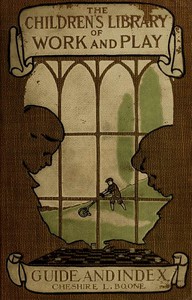
Cheshire L. Boone's Guide and Index (1912) is a hybrid volume that both introduces and catalogs a twelve-book series on practical crafts. Its structure moves between two distinct modes: a set of thematic essays on the significance of manual work, and a detailed index that occupies the bulk of the text. The book's recurring images—photographs of children's projects, diagrams of tools, and scenes of domestic and outdoor life—serve as visual anchors, linking abstract ideas about craft to tangible, often youthful, hands-on activity.
Two-Part Structure: Essay and Index
The volume is divided into two sharply different sections. The first seven chapters present essays with titles such as “Significance of the Crafts in the Life of a People” and “The Real Girl.” These chapters are brief, running roughly from page 3 to page 83, and they argue for the educational and moral value of manual work. The second and much longer section is the index, which begins on page 85 and continues for hundreds of entries. This index is not a simple list but a dense cross-referencing system: entries like “Electricity” branch into subentries for “Ampere's rule,” “chemical transformer,” and “doing chores with,” each with page references to the original series volumes. The shift from flowing prose to compressed, utilitarian listing is abrupt, and the index itself becomes a kind of text to be navigated rather than read linearly.
Recurring Images of Childhood Work
Throughout the essay section, photographs repeatedly show children engaged in making or doing. The frontispiece depicts a “wireless station and workroom of George Riches,” a boy who “made most of the Apparatus at Home or in the School Shop.” Other images show “the work of children between ten and eleven years of age,” clay pots for germination experiments, and a boys' camp with Ernest Thompson Seton. These pictures are not merely illustrative; they function as evidence of the claims Boone makes about the natural creativity of children. The captions often name specific children—Percy Wilson, Donald Mather, Donald Hux—giving the images a documentary quality. The photographs are also carefully placed to face pages discussing related topics, creating a visual rhythm that reinforces the text's argument that craft is both personal and communal.
Movement Between Domestic and Outdoor Settings
The essays and index entries alike move fluidly between indoor and outdoor spaces. Chapter V, “A House and Lot—Especially the Lot,” signals this dual focus in its title. The index includes entries for “Embroidery” and “Needlecraft” alongside “Gardening and Farming,” “Outdoor Sports,” and “Camping.” A single photograph caption reads “A children's garden gives fresh air and sunshine,” while another shows “Domestic science class.” This back-and-forth reflects the series' premise that work and play are not confined to one sphere. Boone's text treats the home workshop, the garden, and the camp as equally valid sites for learning. The photographs reinforce this by alternating images of indoor sewing and outdoor construction, suggesting that the child's world is a continuum of making and doing.
The Index as a Map of Making
The index is the book's most distinctive structural feature. It is not a simple alphabetical list but a dense web of cross-references that mirrors the interconnectedness of the crafts. For example, the entry for “Electricity” includes subentries for “E. M. F., meaning,” “how electricity feels,” and “medical use,” each with page numbers to the volume Electricity and Its Everyday Uses. The index also uses asterisks to mark illustrations, as in “Electric switches, E 74–75 *.” This system turns the index into a navigational tool that rewards browsing: a reader looking up “Embroidery” will find subentries for “bullion stitch,” “Hedebo embroidery,” and “ribbon work,” each leading to different parts of the series. The index thus becomes a miniature map of the entire twelve-volume library, inviting readers to move from one craft to another.
Readers approaching this Guide and Index should be prepared to use it as a reference tool rather than a continuous narrative. The essay chapters offer a period perspective on the philosophy of manual education, while the index provides a practical key to the series. The photographs, though reproduced in black and white, offer glimpses of early twentieth-century childhood and the material culture of making. For those interested in the history of education, craft, or children's literature, this volume serves as a unique portal into a now-vanished world of systematic, hands-on learning.
There’s a particular light in old photographs of children hammering or weaving—hands busy, faces serious. This book’s index stirred that memory of my grandmother’s shelf, where craft and grammar lived side by side. I once found that same quiet dignity in New Century Speaker and Writer: Being a Standard Work on Composition and Oratory — Reading Notes, where words felt as solid as wood, ready to be shaped.