About 66 minutes
Course of Study of the Oakland High School — Reading Notes
Teaching Methods
14,974 recorded words. 5 minutes difference from this book's estimate.
View Gutenberg source #63450
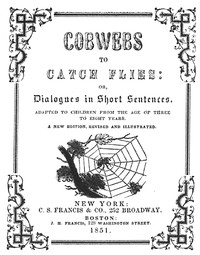
Cobwebs to catch flies — A Reader’s Guide can be approached with a clearer sense of reading commitment from its source measurements: 13,992 words, 1 hr 1 min estimated reading time, and 30 detected text sections.
The text analysis averages about 14.0 words per sentence, while the detected sections provide another way to judge how the source is divided.
Project Gutenberg metadata also associates the work with “Natural history -- Juvenile literature,” connecting these edition facts with the source record’s subject description.
Explore this collection
These alternatives are selected using recorded categories and estimated reading time.
About 66 minutes
Teaching Methods
14,974 recorded words. 5 minutes difference from this book's estimate.
View Gutenberg source #63450About 54 minutes
Teaching Methods
12,399 recorded words. 7 minutes difference from this book's estimate.
View Gutenberg source #12430About 48 minutes
Teaching Methods
10,975 recorded words. 13 minutes difference from this book's estimate.
View Gutenberg source #30957Search stored excerpts and compare books → Choose by your preferences →
Choices use stored catalog measurements. Estimates vary with reading speed. A shared category is a catalog label, not a claim that two books have the same argument or literary quality.
Search reads excerpt text stored with this catalog and links to its associated Gutenberg record. The connection is stored in the site database; this tool does not recheck that every excerpt is word-for-word identical to that external record. Excerpt search does not cover every chapter and does not verify historical publication dates.
Catalog snapshot checked: 2026-09-26. Coverage: 90 public books, 90 available source excerpts.
Calculated from edition completeness, EPUB availability, text structure and catalogue metadata. Not a user rating.
Total of 100 points, scaled to a 2.5-5.0 range. Editions with an empty description or a missing EPUB file are not scored.
Public-domain source text
The source text is kept in the dedicated reader, separate from this catalogue record and its commentary.
Mrs. Lovechild's Cobwebs to catch flies (1851 edition) opens with a striking metaphor: the author promises to catch children 'gently,' whisper moral advice, and release them to play. The book's subtitle—'Dialogues in short sentences adapted to children from the age of three to eight years'—accurately describes its structure: brief exchanges between named children and adults, each illustrating a lesson. Yet the catalog subject 'Natural history' appears only marginally in the excerpts; the text is overwhelmingly concerned with conduct, obedience, and familial affection. The 'Advertisement' reveals the author's deliberate constraint: she writes 'in shackles' to match an infant's vocabulary, a self-imposed limitation that shapes every page.
The longest excerpt describes the Freelove family, where children divide apples into eight pieces, keep the smallest for themselves, and share treasures. The father's rule is absolute: children ask permission for everything, and if refused, 'had no longer a wish to do it.' This is not a gentle negotiation but a system of unquestioning compliance. The mother's reward for William's charity is a kiss and the privilege of carrying a message—a concrete, immediate reinforcement. The family is called 'a family of perfect love,' but the love is conditional on perfect obedience. The dialogue 'Do as you would be done by' is demonstrated twice: once with sheep, once with a poor woman. In both cases, the child performs the action after a brief internal monologue, not spontaneous empathy. The text teaches a calculated morality: think what you would wish, then act accordingly.
The author's 'Advertisement' acknowledges the difficulty of writing in 'short words' and 'short sentences.' The excerpts bear this out: sentences rarely exceed fifteen words, and vocabulary is drawn from domestic life—'bread,' 'sheep,' 'greens,' 'kiss,' 'brother.' The dialogues follow a predictable pattern: a child encounters a situation, asks a question, receives a moral explanation, and acts correctly. For example, William sees a poor woman, thinks 'If I had nothing to eat… what should I wish?', then gives his bread. The repetition of this formula across different scenarios (feeding sheep, sharing at the fair) reinforces the lesson through variation. The structure is pedagogical, not narrative: each dialogue is a self-contained moral demonstration, with little plot continuity between them. This makes the book a tool for repeated reading and recitation, not a story to be consumed once.
Despite the catalog listing 'Natural history -- Juvenile literature,' the excerpts contain only two references to animals: sheep that 'eat out of a person's hand' and 'wild beasts' seen at a fair. Neither is described with any naturalistic detail; the sheep are props for a moral lesson about feeding the hungry, and the wild beasts are merely mentioned among fair attractions. The children's gardens are mentioned—'digging, planting, weeding'—but again, the focus is on cooperation and lending tools, not on botany or biology. The 'Natural history' subject appears to be a cataloger's inference from the title's 'Cobwebs' metaphor and the presence of animals, but the text itself does not teach natural history. Readers expecting facts about insects, plants, or animals will find only moralized anecdotes. The book's true subject is conduct of life, as the second catalog subject correctly indicates.
Readers approaching Cobwebs to catch flies should set aside expectations of natural history instruction. The book is best understood as a period artifact of moral education, where every sentence is engineered to shape behavior through repetition and reward. The short sentences and domestic settings make it accessible to early readers, but the lessons are rigid: obedience brings love, sharing brings happiness, and questioning is discouraged. For modern readers, the interest lies in the tension between the author's stated aim—to please children—and the strict moral framework that governs every interaction.
There’s something tender about these old dialogues—the way they nudge a child toward kindness through tiny domestic scenes. Mrs. Lovechild’s world feels so orderly, yet I found myself wondering about the quieter struggles beneath it. That’s why I keep returning to An essay on the government of children, under three general heads, viz. health, manners, and education — Text and Context; it holds the same gentle questions, asked differently. Neither book quite answers them, but that’s the charm.
Your answers remain private and are stored only in this browser.