About 61 minutes
Cobwebs to catch flies — A Reader’s Guide
Teaching Methods
13,992 recorded words. 5 minutes difference from this book's estimate.
View Gutenberg source #71792
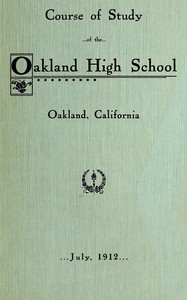
Course of Study of the Oakland High School — Reading Notes can be approached with a clearer sense of reading commitment from its source measurements: 14,974 words, 1 hr 6 min estimated reading time, and 6 detected text sections.
The text analysis averages about 15.2 words per sentence, while the detected sections provide another way to judge how the source is divided.
Project Gutenberg metadata also associates the work with “Education, Secondary -- Curricula -- California -- Oakland,” connecting these edition facts with the source record’s subject description.
Explore this collection
These alternatives are selected using recorded categories and estimated reading time.
About 61 minutes
Teaching Methods
13,992 recorded words. 5 minutes difference from this book's estimate.
View Gutenberg source #71792About 54 minutes
Teaching Methods
12,399 recorded words. 12 minutes difference from this book's estimate.
View Gutenberg source #12430About 48 minutes
Teaching Methods
10,975 recorded words. 18 minutes difference from this book's estimate.
View Gutenberg source #30957Search stored excerpts and compare books → Choose by your preferences →
Choices use stored catalog measurements. Estimates vary with reading speed. A shared category is a catalog label, not a claim that two books have the same argument or literary quality.
Search reads excerpt text stored with this catalog and links to its associated Gutenberg record. The connection is stored in the site database; this tool does not recheck that every excerpt is word-for-word identical to that external record. Excerpt search does not cover every chapter and does not verify historical publication dates.
Catalog snapshot checked: 2026-09-26. Coverage: 90 public books, 90 available source excerpts.
Calculated from edition completeness, EPUB availability, text structure and catalogue metadata. Not a user rating.
Total of 100 points, scaled to a 2.5-5.0 range. Editions with an empty description or a missing EPUB file are not scored.
Public-domain source text
The source text is kept in the dedicated reader, separate from this catalogue record and its commentary.
The 1912 Course of Study of the Oakland High School opens with a dense index of subjects—from Algebra to Zoology—and a stark outline of three distinct courses, each tailored to a specific post-graduation path. The language is administrative and prescriptive, using imperatives like “Insist on discriminating selection” and “Have subjects of importance expanded into special talks.” This voice, consistent throughout, treats the teacher as an executor of a centrally designed plan, not an autonomous professional. The document’s structure mirrors its purpose: to standardize instruction across a growing urban school system. The frequent use of bulleted lists and tabular schedules reinforces a mechanistic view of learning, where time is parceled into precise units and knowledge is a commodity to be delivered.
The document’s language is consistently directive, rarely explanatory. In the English section, teachers are told to “Insist on discriminating selection and judicious condensation” for current events reports. The history department’s aim is stated as “training and information,” with the teacher’s role being to “enable the student better to understand.” This phrasing positions the instructor as a conduit for preordained content rather than a creator of curriculum. The repeated use of “must,” “should,” and “insist on” creates a tone of administrative control. Even the description of General History—which “presents, in the simplest way, an outline”—implies a fixed, simplified narrative. The voice leaves little room for pedagogical flexibility, reflecting a top-down model of education where compliance is valued over innovation.
The document reveals a carefully calibrated pace. The English curriculum for the twelfth year mandates “Every Monday throughout the year” a specific routine of reports on world, national, and local events. This weekly repetition structures the academic calendar into predictable intervals. Similarly, the history courses are sequenced chronologically: Ancient History ends at 800 A.D., Medieval and Modern picks up from there, and English History follows. The outline of courses shows a four-year progression where subjects like Algebra and Geometry are taken in specific years, with electives deferred to later terms. This rigid pacing assumes a uniform student body moving in lockstep. The absence of any mention of remediation or acceleration suggests an expectation that all students progress at the same speed, a hallmark of the era’s factory-model schooling.
While the opening pages offer broad course outlines—listing subjects and years in tabular form—the later sections shift to granular instructional directives. For example, the history department’s description of General History is a single paragraph of general aims, but the Ancient History section specifies the period “from the dawn of history to 800 A. D.” and devotes “the major part of the course” to Greece and Rome. The English section moves from a simple list of years to detailed weekly assignments. This change in pace from overview to specificity mirrors the document’s dual function: to inform administrators of the curriculum’s scope and to guide teachers in daily practice. The contrast between the sparse outline on pages 4–6 and the dense prose of later pages highlights the tension between standardization and the need for practical classroom guidance.
Readers should note that this document is a blueprint, not a record of implementation. The excerpts provide no evidence of how teachers actually used these instructions or how students responded. The voice remains consistently administrative, never venturing into student experience or classroom dynamics. To understand the lived reality of Oakland High School in 1912, one would need supplementary sources—student work, teacher diaries, or newspaper accounts. As a historical artifact, this course of study is valuable precisely for what it omits: the messy, human side of education that no curriculum guide can fully capture.
I found myself thinking about that 1912 Oakland syllabus the other day, its strict schedules and civic lectures feeling less like rules and more like a quiet blueprint for a whole generation’s hopes. It reminded me of sitting with The Library of Work and Play: Guide and Index — Text and Context, that gentle way it frames learning as a kind of daily craft, not a race. Both left me with a soft ache for a slower, more deliberate time.
Build a private reading journal entry for this title.