About 546 minutes
Educating by story-telling — Background and Themes
Teaching Methods
125,447 recorded words. 14 minutes difference from this book's estimate.
View Gutenberg source #58255
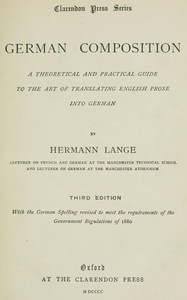
The catalog record for German composition — Key Ideas to Explore provides practical reading context through 128,628 words, 9 hr 20 min estimated reading time, and 262 detected text sections.
The text analysis averages about 11.8 words per sentence, while the detected sections provide another way to judge how the source is divided.
Project Gutenberg metadata also associates the work with “German language -- Composition and exercises,” connecting these edition facts with the source record’s subject description.
Explore this collection
These alternatives are selected using recorded categories and estimated reading time.
About 546 minutes
Teaching Methods
125,447 recorded words. 14 minutes difference from this book's estimate.
View Gutenberg source #58255About 482 minutes
Teaching Methods
110,691 recorded words. 78 minutes difference from this book's estimate.
View Gutenberg source #38046About 656 minutes
Teaching Methods
150,691 recorded words. 96 minutes difference from this book's estimate.
View Gutenberg source #60064Search stored excerpts and compare books → Choose by your preferences →
Choices use stored catalog measurements. Estimates vary with reading speed. A shared category is a catalog label, not a claim that two books have the same argument or literary quality.
Search reads excerpt text stored with this catalog and links to its associated Gutenberg record. The connection is stored in the site database; this tool does not recheck that every excerpt is word-for-word identical to that external record. Excerpt search does not cover every chapter and does not verify historical publication dates.
Catalog snapshot checked: 2026-09-26. Coverage: 90 public books, 90 available source excerpts.
Calculated from edition completeness, EPUB availability, text structure and catalogue metadata. Not a user rating.
Total of 100 points, scaled to a 2.5-5.0 range. Editions with an empty description or a missing EPUB file are not scored.
Public-domain source text
The source text is kept in the dedicated reader, separate from this catalogue record and its commentary.
Hermann Lange's German Composition (1900) opens with a preface that positions the book as both a theoretical and practical guide, explicitly targeting students who have completed the fiftieth lesson of his German Manual. The work's structure immediately signals a dual purpose: it aims to serve examination requirements while also offering literary extracts chosen for their adaptability to translation. The preface's careful enumeration of target exams—from London and Victoria Universities to Civil Service tests—reveals an institutional context that shapes the book's pedagogical approach.
The book's early sections present a dense framework of grammatical rules and translation notes, as seen in Section 162's treatment of 'A Royal Judgment.' Here, each English sentence is followed by numbered annotations directing the student to specific grammar points—such as the use of the dative with an or the imperative to use the second person plural Ihr for historical address. This creates a stop-start rhythm, where the narrative flow is repeatedly interrupted by technical commentary. The pace is deliberate and analytical, mirroring the step-by-step acquisition of compositional skills.
Later sections, however, introduce longer, uninterrupted passages. Section 163's excerpt on Tacitus, for instance, presents a continuous paragraph of advice on reading the historian, with fewer interlinear notes. The shift suggests a progression from guided translation to more independent engagement. The annotations themselves become sparser, trusting the student to apply earlier lessons. This change in pace—from fragmented to fluid—reflects the book's underlying arc: moving from mechanical rule application to the appreciation of style and content.
Lange's annotations frequently comment on register and historical appropriateness. In Section 162, he instructs the student to use Ihr for addressing Queen Elizabeth, noting that 'that was the pronoun generally used in addressing persons in olden times.' This attention to linguistic nuance reveals a concern for voice beyond mere grammatical correctness. The translator is asked to consider the social and temporal context of the dialogue, embedding a layer of historical authenticity into the translation.
Similarly, the Tacitus passage advises that the student 'exercise yourself frequently in trying to make translations,' emphasizing practice as a means to internalize the author's 'quaint and enigmatical' style. Lange's own voice as instructor is direct and prescriptive, yet he occasionally shifts to a more conversational tone—'I am glad to find… that you are reading Tacitus with some relish'—creating a simulated dialogue between teacher and student. This interplay of formal instruction and personal address mirrors the translator's task of balancing fidelity to the source text with naturalness in the target language.
The book's organization is itself a pedagogical tool. Each section pairs an English passage with a German translation and a set of numbered notes keyed to specific words or phrases. This structure forces the student to move back and forth between text and commentary, building a habit of analytical reading. The notes often provide alternative renderings or explain idiomatic choices, as when Lange suggests that inserting auch after the verb 'caused' would 'considerably improve the German rendering' of a sentence about Queen Mary's death.
Beyond individual sections, the overall sequence of extracts—from historical narratives to literary criticism—offers exposure to varied prose styles. The preface claims that the pieces 'represent all the various styles of English Prose Composition,' and the selection indeed spans from dramatic anecdotes to reflective essays. This variety serves as a scaffold for the translator, who must adapt technique to genre. The book's architecture thus mirrors its stated goal: not merely to teach rules, but to cultivate an art of translation responsive to context and tone.
Readers approaching German Composition should attend to the interplay between its prescriptive notes and the literary texture of its extracts. The book rewards those who move beyond rote application to consider how Lange's choices—in register, syntax, and annotation—model the translator's craft. It is a document of its era's pedagogical methods, yet its focus on the art of rendering English into idiomatic German remains relevant for anyone studying historical approaches to language instruction.
That rainy afternoon, I kept returning to Lange’s gradual shift from rules to stories—how grammar loosened into rhythm. It reminded me of another old teaching text, one that treated French with the same affectionate, puzzled care. I found myself pulling it from the shelf almost without thinking: John Bull, Junior; or, French as She is Traduced — Edition Insights. Both books felt like quiet conversations across languages, patient and slightly amused.
Answer a few questions and save a private reflection on this device.