About 82 minutes
The 1926 Tatler — Reading Notes
Schools Learning
18,697 recorded words. 12 minutes difference from this book's estimate.
View Gutenberg source #25926
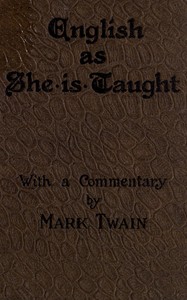
This digital edition of English as She is Taught Being Genuine Answers to Examination Questions in Our Public Schools — Story, Setting & Ideas is described by source-level measurements including 21,618 words, 1 hr 34 min estimated reading time, and 21 detected text sections.
The text analysis averages about 13.2 words per sentence, while the detected sections provide another way to judge how the source is divided.
Project Gutenberg metadata also associates the work with “English language -- Errors of usage -- Humor,” connecting these edition facts with the source record’s subject description.
Explore this collection
These alternatives are selected using recorded categories and estimated reading time.
About 82 minutes
Schools Learning
18,697 recorded words. 12 minutes difference from this book's estimate.
View Gutenberg source #25926About 111 minutes
Schools Learning
25,323 recorded words. 17 minutes difference from this book's estimate.
View Gutenberg source #60816About 114 minutes
Schools Learning
26,057 recorded words. 20 minutes difference from this book's estimate.
View Gutenberg source #52653Search stored excerpts and compare books → Choose by your preferences →
Choices use stored catalog measurements. Estimates vary with reading speed. A shared category is a catalog label, not a claim that two books have the same argument or literary quality.
Search reads excerpt text stored with this catalog and links to its associated Gutenberg record. The connection is stored in the site database; this tool does not recheck that every excerpt is word-for-word identical to that external record. Excerpt search does not cover every chapter and does not verify historical publication dates.
Catalog snapshot checked: 2026-09-26. Coverage: 90 public books, 90 available source excerpts.
Calculated from edition completeness, EPUB availability, text structure and catalogue metadata. Not a user rating.
Total of 100 points, scaled to a 2.5-5.0 range. Editions with an empty description or a missing EPUB file are not scored.
Public-domain source text
The source text is kept in the dedicated reader, separate from this catalogue record and its commentary.
This volume presents a startlingly honest record of student answers to examination questions in late-nineteenth-century American public schools. Compiled by teacher Caroline B. Le Row and introduced by Mark Twain—who called it “a darling literary curiosity”—the book reproduces responses verbatim, without correction or embellishment. The result is a series of linguistic misadventures that reveal not ignorance but a peculiar, often logical, reworking of literary passages. Twain’s preface sets the tone: he insists the examples are genuine, “none of them have been tampered with, or doctored in any way.” Readers encounter, for instance, a student’s rendering of a line from Bulwer-Lytton: “Youth, which fate reserves for a bright manhood, there’s no such word as Fail” becomes “The youth who is in his lexicon and about to spring into a bright manhood, the word fail he knows not.” Such transformations invite us to consider what these young minds actually understood.
The student answers often follow a discernible internal logic, even as they depart wildly from the source. A passage from Scott’s The Lady of the Lake describing a hunted stag is rendered: “The man who rode on the horse performed the whip and an instrument made of steel alone with strong ardor not diminishing, for, being tired from the time passed with hard labor overworked with anger and ignorant with weariness, while every breath for labor he drew with cries full of sorrow, the young deer made imperfect who worked hard filtered in sight.” Here, the student retains key elements—the horseman, the whip, the exhausted stag—but reorders and reinterprets them, creating a narrative that is almost a paraphrase, yet entirely original. Such responses suggest that the students were not simply guessing but actively constructing meaning from fragments they recognized, however imperfectly.
Caroline B. Le Row’s role as compiler is crucial: she selected and arranged the answers without correction, allowing the reader to encounter the errors as raw data. Mark Twain’s commentary, excerpted from a Century article, frames the collection as a curiosity, but his tone is more amused than scornful. He notes that “the collection is made by a teacher” and that the examples are genuine, which lends the book an ethnographic quality. The publisher’s note adds a transatlantic dimension, observing that seventeen of the American mistakes appear in similar form in an English article on “Boys’ Blunders,” suggesting a shared pedagogical culture. This framing encourages readers to see the errors not as individual failures but as symptoms of a system—a point reinforced by the Dickens epigraph about Dr. Blimber’s forcing-house.
Certain patterns recur across the excerpts. Students frequently conflate abstract nouns with concrete ones: “Memory” becomes “Mearcy,” “Reason” becomes “shining our brains.” They also tend to personify or literalize metaphors. In a response to George Eliot’s The Spanish Gypsy, one student writes: “Man is guided by two spirits, evil and good, and if the evil spirit (before he was a good one) had been a good one, man would not have been created.” This introduces a theological speculation entirely absent from the original. Another common feature is the collapse of syntax into parataxis: clauses are strung together with “and” or “but,” creating a breathless, additive style. These patterns suggest that students were grappling with unfamiliar vocabulary and complex sentence structures by applying familiar narrative or moral frameworks.
The excerpts offer indirect evidence of what was being taught and how. The prevalence of Romantic and Victorian poetry—Bryant, Scott, Bulwer-Lytton, George Eliot—indicates a canon focused on moral uplift and nature. Yet the students’ responses show that the language of these poems often failed to communicate its intended meaning. For instance, Bryant’s “Thanatopsis” is transformed into a statement about a man who “loves his nature” and “holds connections with his form in a visible manner.” The student seems to have understood individual words but not their poetic context. This suggests a pedagogy that emphasized memorization over comprehension. Twain’s commentary implicitly critiques this approach, and the book as a whole stands as a document of the gap between curriculum and student understanding in the nineteenth-century classroom.
Reading English as She is Taught requires a shift in perspective: these are not mistakes to be laughed at but artifacts of a particular moment in educational history. The compiler’s decision to present the answers without correction allows us to see the students’ thought processes at work. Twain’s framing reminds us that the humor lies not in the students’ ignorance but in the system that produced such responses. For modern readers, the book offers a rare, unmediated glimpse into the minds of nineteenth-century schoolchildren, and a cautionary tale about the gap between what is taught and what is learned.
I found myself smiling at the kids’ wrong answers in that exam book — the way their minds bent grammar into something oddly honest. It reminded me how much care goes into shaping those very pages, the physical craft that carries such mistakes forward. Printing and bookbinding for schools — Text and Context stayed with me afterwards, quiet and warm, like watching hands fold paper around a thought.
Save your reaction, strongest insight, and memorable passage.