About 656 minutes
Dorothea Beale of Cheltenham — Inside the Classic
Teaching Methods
150,691 recorded words. 400 minutes difference from this book's estimate.
View Gutenberg source #60064
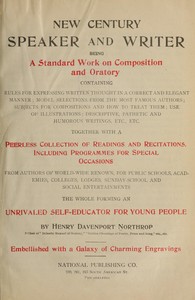
For New Century Speaker and Writer: Being a Standard Work on Composition and Oratory — Reading Notes, the stored edition analysis reports 242,651 words, 17 hr 36 min estimated reading time, and 57 detected text sections.
The text analysis averages about 15.3 words per sentence, while the detected sections provide another way to judge how the source is divided.
Project Gutenberg metadata also associates the work with “Elocution,” connecting these edition facts with the source record’s subject description.
Explore this collection
These alternatives are selected using recorded categories and estimated reading time.
About 656 minutes
Teaching Methods
150,691 recorded words. 400 minutes difference from this book's estimate.
View Gutenberg source #60064About 560 minutes
Teaching Methods
128,628 recorded words. 496 minutes difference from this book's estimate.
View Gutenberg source #76864About 546 minutes
Teaching Methods
125,447 recorded words. 510 minutes difference from this book's estimate.
View Gutenberg source #58255Search stored excerpts and compare books → Choose by your preferences →
Choices use stored catalog measurements. Estimates vary with reading speed. A shared category is a catalog label, not a claim that two books have the same argument or literary quality.
Search reads excerpt text stored with this catalog and links to its associated Gutenberg record. The connection is stored in the site database; this tool does not recheck that every excerpt is word-for-word identical to that external record. Excerpt search does not cover every chapter and does not verify historical publication dates.
Catalog snapshot checked: 2026-09-26. Coverage: 90 public books, 90 available source excerpts.
Calculated from edition completeness, EPUB availability, text structure and catalogue metadata. Not a user rating.
Total of 100 points, scaled to a 2.5-5.0 range. Editions with an empty description or a missing EPUB file are not scored.
Public-domain source text
The source text is kept in the dedicated reader, separate from this catalogue record and its commentary.
Henry Davenport Northrop's New Century Speaker and Writer (1901) presents itself as a comprehensive self-educator for young people, yet its contents reveal a persistent tension between the orderly rules it prescribes and the fervent, emotionally charged selections it showcases. The preface promises instruction in expressing written thought in a 'correct and elegant manner,' but the model readings—such as Thomas Francis Meagher's oration on patriotism—overflow with dramatic exhortations and grand historical allusions. This contrast between the manual's systematic guidance and the unrestrained passion of its examples suggests that the work's underlying pedagogy values emotional impact as much as formal correctness.
The preface frames the book as a response to a 'very great demand' for standard instruction in elegant writing and effective recitation. Northrop emphasizes that the treatment of composition is 'masterly and thorough' and that the rules are 'right to the point.' Yet the language of the preface itself is promotional and hyperbolic, calling the work 'incomparable' and promising that the study becomes 'a delight.' This promotional tone sits uneasily with the ideal of dispassionate instruction. Moreover, the preface lists 'more than 500 choice subjects for compositions' alongside 'Masterpieces of Composition' by authors like Emerson and George Eliot, implying that imitation of genius is the path to skill—a method that prioritizes inspiration over incremental practice.
Thomas Francis Meagher's 'Patriotism a Reality' is introduced with a note that it 'must not be delivered in any feeble halting manner, but with all your nerve and energy.' The speech itself is a torrent of rhetorical questions, exclamations, and historical invocations—from Wallace to Joan of Arc to William Tell. Meagher condemns 'money making in the public forum' and calls for patriotism to be 'a gallant sacrifice, not a vulgar game.' The language is deliberately archaic and elevated, with phrases like 'scourge it from the hustings' and 'the virtue that gave to Paganism its dazzling lustre.' This selection exemplifies the book's preference for oratory that is emotionally stirring rather than logically structured, a choice that may surprise readers expecting a neutral instructional text.
Lord Macaulay's 'The Glory of Athens' is presented with the remark that its final paragraph—predicting England's eventual decay—'has created an endless amount of comment and criticism.' The excerpt itself celebrates Athens as the source of all triumphs of 'truth and genius over prejudice and power,' claiming that wherever liberty and reason have advanced, 'there has been her spirit in the midst of them.' This selection, like Meagher's, is built on grand historical parallels and a tone of moral certainty. The editorial note draws attention to the controversial prediction of decline, hinting that the book values selections that provoke debate. The inclusion of such a piece underscores the work's interest in oratory as a vehicle for national and moral instruction, even at the cost of internal consistency with its own compositional advice.
Readers approaching this volume should be prepared for a work that is less a neutral textbook than a curated anthology with a strong rhetorical agenda. The tension between its prescriptive framework and its passionate examples invites reflection on what 'correct and elegant' expression truly meant at the turn of the twentieth century. The book rewards those who read not only the rules but also the choices behind the selections, revealing a vision of eloquence that is as much about stirring the heart as about pleasing the ear.
Reading New Century Speaker and Writer felt like holding someone's earnest, trembling effort to teach beauty by the numbers. The strict rules crumble next to the passionate models it quotes. It made me think of another patient, complex soul trying to shape young minds within strict forms — Dorothea Beale of Cheltenham — Inside the Classic. The same quiet ache of wanting freedom for others while living by the rulebook.
Build a private reading journal entry for this title.