About 33 minutes
Fifteen Institute Lessons in Language, Arithmetic, and U.S. History — Inside the Classic
Teaching Methods
7,450 recorded words. 9 minutes difference from this book's estimate.
View Gutenberg source #52429
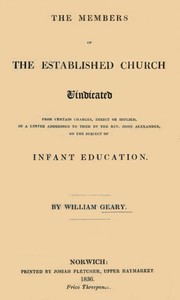
Before opening The Members of the Established Church Vindicated from certain charges, direct or implied, in a letter addressed to them by the Rev. John Alexander, on the subject of — Text and Context, the edition data offers a quick orientation: 5,338 words, 24 min estimated reading time, and 1 detected text section.
The text analysis averages about 26.7 words per sentence, while the detected sections provide another way to judge how the source is divided.
Project Gutenberg metadata also associates the work with “Church and education -- England,” connecting these edition facts with the source record’s subject description.
Explore this collection
These alternatives are selected using recorded categories and estimated reading time.
About 33 minutes
Teaching Methods
7,450 recorded words. 9 minutes difference from this book's estimate.
View Gutenberg source #52429About 33 minutes
Teaching Methods
7,385 recorded words. 9 minutes difference from this book's estimate.
View Gutenberg source #64819About 48 minutes
Teaching Methods
10,975 recorded words. 24 minutes difference from this book's estimate.
View Gutenberg source #30957Search stored excerpts and compare books → Choose by your preferences →
Choices use stored catalog measurements. Estimates vary with reading speed. A shared category is a catalog label, not a claim that two books have the same argument or literary quality.
Search reads excerpt text stored with this catalog and links to its associated Gutenberg record. The connection is stored in the site database; this tool does not recheck that every excerpt is word-for-word identical to that external record. Excerpt search does not cover every chapter and does not verify historical publication dates.
Catalog snapshot checked: 2026-09-26. Coverage: 90 public books, 90 available source excerpts.
Calculated from edition completeness, EPUB availability, text structure and catalogue metadata. Not a user rating.
Total of 100 points, scaled to a 2.5-5.0 range. Editions with an empty description or a missing EPUB file are not scored.
Public-domain source text
The source text is kept in the dedicated reader, separate from this catalogue record and its commentary.
William Geary's 1836 pamphlet opens with a measured tone, describing the letter he responds to as 'characterized by a spirit of mildness and conciliation' even as he sets out to refute its charges. The work is a tightly argued defense, structured around three main accusations: that church members acted unkindly regarding an exhibition in St. Andrew's Hall, that they proposed an exclusive society, and that a broader society would have been more beneficial. Geary's method is to present a detailed narrative of events, quoting agreements and distributions of tickets to show fairness. The pamphlet's voice is that of a careful chronicler, not a fiery polemicist, aiming to 'set the public right' rather than inflame division.
Geary organizes his defense around three numbered charges, each addressed in turn. This clear structure allows him to methodically dismantle Alexander's claims. For the first charge, he recounts the planning of the exhibition, noting that free tickets were distributed to Dissenting congregations—300 tickets to various groups in the city. He emphasizes that the exhibition was 'Mr. Wilderspin's own speculation,' not a church project, and that church members merely supported it to promote infant education. The second charge he dismisses as 'perfectly groundless,' a phrase that signals his confidence in the evidence. The third charge he treats as a hypothetical, arguing that a mixed society would not necessarily have been more effective. This logical progression gives the pamphlet a forensic quality, as if Geary is building a case for a jury.
Geary's word choice reveals a deliberate strategy: he avoids inflammatory language, instead using terms like 'erroneous impressions' and 'momentary' consequences. He describes his opponents' actions as 'unkindly and disrespectfully' but immediately counters with evidence of inclusion. The phrase 'with his usual liberality' applied to Wilderspin suggests a pattern of generosity. Geary also employs legalistic phrasing—'the parties in question,' 'the main charges appear to be'—which frames the dispute as a matter of fact, not feeling. This diction aims to position the author as reasonable and the accuser as mistaken, not malicious. The pamphlet's tone is consistent: calm, precise, and focused on documentation rather than rhetoric.
Geary grounds his argument in specific details: the number of tickets (300), the venue (St. Andrew's Hall), and the financial arrangement (no remuneration, only indemnity from loss). He reports that Wilderspin was 'distinctly asked whether the directors or the committee of those schools had been consulted' and replied 'plainly' that there would be no difficulty. This reliance on reported speech and concrete numbers gives the pamphlet an evidentiary weight. Geary does not speculate about motives; he presents actions and their contexts. The reader is left to judge whether the church members acted reasonably. This approach is effective for a short pamphlet (5,338 words) where every sentence must contribute to the defense.
The available excerpt covers only the opening pages of Geary's pamphlet, including the list of charges and the beginning of his response to the first charge. The full text likely continues with detailed rebuttals of each charge, possibly including further correspondence or testimony. Based on the excerpt, Geary's style is orderly and evidence-based, but we cannot know how he handles the later charges or whether he introduces new arguments. The pamphlet's title promises a 'vindication,' and the opening suggests a thorough defense, but the complete reasoning remains partly obscured. Readers should approach the text as a fragment of a larger polemical exchange, one that reflects early Victorian debates over religious involvement in education.
Geary's pamphlet is best read as a specimen of early Victorian religious controversy, where local disputes over infant education became proxies for broader tensions between Church and Dissent. His method—calm, factual, and structured—offers a contrast to more heated polemics of the era. Readers interested in the history of education or church-state relations will find this a concise case study. The pamphlet's brevity and focus make it accessible, but its incomplete excerpt leaves some questions unanswered about the full scope of Geary's argument.
Holding Geary’s pamphlet, I recalled the hush of a library corner where I first met Fifteen Institute Lessons in Language, Arithmetic, and U.S. History — Inside the Classic — that same feeling of watching a quarrel cooled by careful footnotes. Both books whisper that dignity lives in the margin, in evidence set down gently, like a hand resting on a table. Fifteen Institute Lessons in Language, Arithmetic, and U.S. History — Inside the Classic offered that same strange comfort once, and I carry it still.
Save your reaction, strongest insight, and memorable passage.