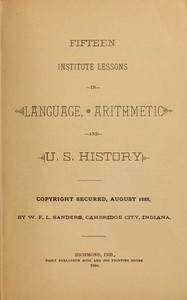
The work opens with detailed directions for teaching language, urging teachers to question students about objects and incidents in reading lessons, place difficult words on the board for rapid pronunciation and spelling, and have pupils pass through paragraphs naming parts of speech, phrases, and propositions. The method stresses close attention to position, voice, emphasis, and tone, with the goal that good reading should resemble good conversation.
This emphasis on oral recitation and board work recurs across all three subjects, suggesting a classroom where the teacher’s voice and the chalkboard are central tools.
A Tripartite Structure for Each Lesson
Each of the fifteen lessons is divided into three distinct sections: Language, Arithmetic, and U.S. History. This consistent tripartite structure imposes a rhythm on the teacher’s week, moving from verbal analysis to numerical problem-solving to historical chronology. The Language section often begins with exercises in correction or parsing, the Arithmetic section presents problems and rules, and the History section offers outlines of presidential terms or key events. The work does not explain why these three subjects are paired; the reader must infer that the author saw them as complementary disciplines of analysis and memory.
The transitions between subjects are abrupt, with no connective commentary. This suggests the lessons were designed for a single class session or a series of institute meetings, where each subject received focused time.
Recurring Images of Board Work and Oral Recitation
Throughout the excerpts, the blackboard appears as a persistent prop. The teacher is instructed to place words on the board, write analyses, and have pupils recite from board notes. In the History section, a model for the teacher shows a board divided into columns for Times, Places, Persons, and Miscellaneous items, with dictionary work and general topics listed below. This visual organization turns historical narrative into a grid of discrete facts.
Oral recitation is equally emphasized. Pupils are to “recite” elements by stating how or why the author used a word or phrase. The work insists that this recitation is “necessarily short” but brings language and understanding into use. The classroom imagined here is one of constant verbal performance, with the teacher questioning listeners after a pupil reads aloud.
Movement Between Scales: From Words to Narratives
The lessons move from micro to macro. In Language, pupils start with individual words (pronunciation, spelling) then progress to phrases, propositions, and sentences. In History, the teacher’s analysis breaks a passage into elements of time, place, person, and miscellaneous items, then combines these into general topics. The model provided for the Eclectic U.S. History shows this progression: from a list of times and places to a set of general topics like “A Lonely Land” and “The Mound-builders.”
This scaffolding implies that understanding a historical narrative requires first mastering its component facts. The work does not discuss synthesis or interpretation beyond combining elements; the goal appears to be accurate recall and recitation of the author’s content.
The History Section’s Tabular View of Presidential Terms
The U.S. History section includes tables of presidential terms, such as the Fourth Presidential Term (1801) and the Second Presidential Term (1793). These tables list opposing parties (Federal vs. Republican), key events (Louisiana Purchase, Whiskey Insurrection), and electoral votes. The transcriber’s note warns that the presidential terms are not in chronological order, which may reflect the original printing or the author’s thematic arrangement.
The tables reduce complex political conflicts to parallel columns of party positions. For example, under 1801, Jefferson is called “an atheist; a fanatic in politics” by Federalists, while his party is labeled “disorganizers and revolutionists.” The work does not analyze these claims; it presents them as facts to be memorized.
Readers approaching this manual should expect a prescriptive, teacher-centered method that values oral drill and board work over discussion or creative writing. The lessons offer a window into late-19th-century institute pedagogy, where the teacher’s role was to parse knowledge into digestible units and test recall. The work’s value lies not in its historical accuracy but in its demonstration of a systematic teaching approach.
That old manual made me think of my grandfather’s desk, where rigid lessons felt like quiet doors. I once found a similar hush in Course of Study of the Oakland High School — Reading Notes, its lists of required pages whispering forgotten mornings. Both hold that peculiar stillness—not of dust, but of attentive breaths held over small, certain tasks.