About 560 minutes
German composition — Key Ideas to Explore
Teaching Methods
128,628 recorded words. 96 minutes difference from this book's estimate.
View Gutenberg source #76864
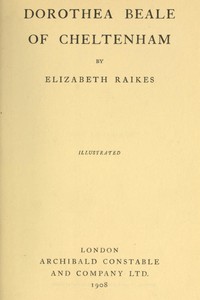
Before opening Dorothea Beale of Cheltenham — Inside the Classic, the edition data offers a quick orientation: 150,691 words, 10 hr 56 min estimated reading time, and 21 detected text sections.
The text analysis averages about 20.4 words per sentence, while the detected sections provide another way to judge how the source is divided.
Project Gutenberg metadata also associates the work with “Beale, Dorothea, 1831-1906,” connecting these edition facts with the source record’s subject description.
Explore this collection
These alternatives are selected using recorded categories and estimated reading time.
About 560 minutes
Teaching Methods
128,628 recorded words. 96 minutes difference from this book's estimate.
View Gutenberg source #76864About 546 minutes
Teaching Methods
125,447 recorded words. 110 minutes difference from this book's estimate.
View Gutenberg source #58255About 482 minutes
Teaching Methods
110,691 recorded words. 174 minutes difference from this book's estimate.
View Gutenberg source #38046Search stored excerpts and compare books → Choose by your preferences →
Choices use stored catalog measurements. Estimates vary with reading speed. A shared category is a catalog label, not a claim that two books have the same argument or literary quality.
Search reads excerpt text stored with this catalog and links to its associated Gutenberg record. The connection is stored in the site database; this tool does not recheck that every excerpt is word-for-word identical to that external record. Excerpt search does not cover every chapter and does not verify historical publication dates.
Catalog snapshot checked: 2026-09-26. Coverage: 90 public books, 90 available source excerpts.
Calculated from edition completeness, EPUB availability, text structure and catalogue metadata. Not a user rating.
Total of 100 points, scaled to a 2.5-5.0 range. Editions with an empty description or a missing EPUB file are not scored.
Public-domain source text
The source text is kept in the dedicated reader, separate from this catalogue record and its commentary.
The preface immediately establishes that the biography is built on Dorothea Beale's own carefully preserved documents—minutes, letters, diaries, and autobiographical fragments—and her 1900 history of the Ladies' College. Raikes states she followed Beale's suggestions to emphasize the work over the person, yet also aimed to show what Beale was to those she inspired. This dual purpose shapes the entire narrative: the reader encounters a life told through institutional records and personal reflections, with Beale's own voice emerging in quoted passages like her opening autobiographical fragment.
The autobiographical fragment in the preface reveals Beale's intention to relate only those things that exercised a formative influence on her character, under God's Providence, to fit her for her work. She mentions childhood circumstances, family influences, chance acquaintances, and passing remarks as viewed from within. This inward-looking approach contrasts with the outward institutional history she compiled. The reader should note how Raikes interweaves these personal fragments with official documents, creating a layered portrait where Beale's self-perception is set against the record of her achievements.
A middle excerpt presents a lengthy letter from Mr. Brancker discussing a plan for training governesses through a pupil-teacher system. The letter reveals detailed negotiations about fees, boarding, and the preference for College pupils. Brancker's proposal to pay fees and half boarding-house expenses, and his emphasis on association with the College as a hold on pupils, shows the practical thinking behind St. Hilda's. Raikes then notes that these ideas were carried out, and that Beale disliked scholarships, preferring loans that would embrace and ennoble character. This section demonstrates how Raikes uses correspondence to illustrate Beale's educational philosophy in action.
Following the Brancker letters, Raikes discusses the Loan Fund that assisted over a hundred students. She explains Beale's objections to scholarships: Beale thought people should pay for advantages to value them more, and that a mere gift seemed less valuable than self-denial. This passage reveals Beale's belief that financial arrangements should build character. The reader sees how Raikes connects specific institutional decisions—like the founding of St. Hilda's—to Beale's broader principles, using the loan fund as a concrete example of her philosophy of giving that 'would embrace and ennoble character.'
The excerpts suggest a biography that moves between chronological narrative and thematic analysis. The preface indicates that Beale left ample materials for a history of her work, and Raikes follows that lead. The reader should expect a text that frequently quotes letters and documents, with Raikes providing context and interpretation. The later excerpt on the loan fund shows how Raikes synthesizes multiple sources—letters, Beale's writings, and her own knowledge—to present a coherent picture. The biography is not a simple life story but an argument about how Beale's character shaped the College.
Readers approaching this biography should attend to the interplay between Beale's own words and Raikes's framing. The preface sets expectations for a work that prioritizes institutional history over personal revelation, yet the excerpts show that personal letters and autobiographical fragments are central. The book rewards attention to how Raikes selects and arranges her sources, as each document serves to illuminate both Beale's character and the College's development. This is a biography that demands active reading, tracing the threads from personal conviction to institutional legacy.
Reading how Raikes wove Dorothea’s own letters into the school’s story, I remembered a quiet afternoon with Business English: A Practice Book — Text and Context, where the stiff exercise pages suddenly felt like someone’s careful hand, correcting margins, guiding a stranger’s prose. That same ache of being spoken to across decades, not about facts, but about patient, human work, lingered here. Both books left me holding my own pencil differently.
Your answers remain private and are stored only in this browser.