About 560 minutes
German composition — Key Ideas to Explore
Teaching Methods
128,628 recorded words. 14 minutes difference from this book's estimate.
View Gutenberg source #76864
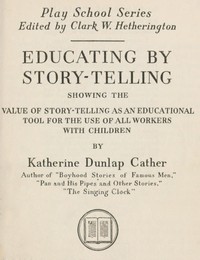
Before opening Educating by story-telling — Background and Themes, the edition data offers a quick orientation: 125,447 words, 9 hr 6 min estimated reading time, and 16 detected text sections.
The text analysis averages about 18.9 words per sentence, while the detected sections provide another way to judge how the source is divided.
Project Gutenberg metadata also associates the work with “Storytelling,” connecting these edition facts with the source record’s subject description.
Explore this collection
These alternatives are selected using recorded categories and estimated reading time.
About 560 minutes
Teaching Methods
128,628 recorded words. 14 minutes difference from this book's estimate.
View Gutenberg source #76864About 482 minutes
Teaching Methods
110,691 recorded words. 64 minutes difference from this book's estimate.
View Gutenberg source #38046About 457 minutes
Teaching Methods
105,014 recorded words. 89 minutes difference from this book's estimate.
View Gutenberg source #57667Search stored excerpts and compare books → Choose by your preferences →
Choices use stored catalog measurements. Estimates vary with reading speed. A shared category is a catalog label, not a claim that two books have the same argument or literary quality.
Search reads excerpt text stored with this catalog and links to its associated Gutenberg record. The connection is stored in the site database; this tool does not recheck that every excerpt is word-for-word identical to that external record. Excerpt search does not cover every chapter and does not verify historical publication dates.
Catalog snapshot checked: 2026-09-26. Coverage: 90 public books, 90 available source excerpts.
Calculated from edition completeness, EPUB availability, text structure and catalogue metadata. Not a user rating.
Total of 100 points, scaled to a 2.5-5.0 range. Editions with an empty description or a missing EPUB file are not scored.
Public-domain source text
The source text is kept in the dedicated reader, separate from this catalogue record and its commentary.
Katherine Dunlap Cather's Educating by Story-Telling opens with a direct claim: the book grew from years of work with children, parents, teachers, and librarians, and was first shaped in a 1914 University of California Summer Session course. Rather than offering a general theory, Cather presents a structured method for selecting, adapting, and telling stories to achieve specific educational aims. The text moves between instructional chapters and full story texts—such as the adapted folk tale of Little Pig who tries violin, cheese-making, and beekeeping before returning to his garden—demonstrating principles through example. This dual structure, part manual and part anthology, invites the reader to see storytelling not as entertainment but as a deliberate craft tied to child development.
The book belongs to the Play School Series, edited by Clark W. Hetherington, which replaces traditional subjects with a curriculum of natural child activities. Cather’s volume treats storytelling as one such activity, alongside social, linguistic, moral, and physical play. The preface emphasizes that the material was tested in real settings—summer sessions, private classes, and lecture work—and refined by children’s responses. This practical origin shapes the book’s tone: it is less a theoretical treatise than a field guide. The author states plainly that she does not claim to offer the final word, but that the eagerness with which parents and teachers received her principles convinced her of the book’s unique value. The structure thus mirrors the progressive education movement of the 1910s, where learning emerged from doing.
The excerpted story of Little Pig illustrates Cather’s method in miniature. The pig tries four occupations—gardening, violin-playing, cheese-making, beekeeping—each time encountering a difficulty that drives him back to his original carrot patch. The narrative pattern is repetitive: a desire for ease, a brief apprenticeship, a painful or tedious obstacle, and a return. The cat says, “He who would play the violin must work”; the dog insists, “There can be no rest time until the work is done”; the bee man notes, “You cannot be a beekeeper without getting stung.” Each line reinforces the same moral through slightly varied phrasing. Cather likely chose this structure to make the lesson about perseverance memorable through rhythm and accumulation, not through explicit preaching.
Cather’s story moves the pig from garden to cat’s door, to dog’s hut, to bee man’s meadow, and back to garden. Each setting is sketched with minimal detail—a door, a river, a green field—enough to signal a new trial without distracting from the action. The pig’s journey is linear but circular: he returns to his starting point, now content. This spatial structure mirrors the educational principle Cather advocates: children learn by trying, failing, and returning to familiar ground with new understanding. The repeated phrase “he started down the road” creates a forward momentum that keeps young listeners engaged, while the final homecoming provides closure. The story’s economy of scene changes suggests Cather valued clarity over ornament in tales meant for oral delivery.
The dialogue in the Little Pig story is direct and colloquial: “Will you teach me to play the violin, friend cat?” and “Oh! he cried; ‘this isn’t music!’” The cat’s reply is flat and patient: “Of course not. You haven’t tried long enough.” This exchange typifies Cather’s approach to adaptation—she retains the folk tale’s simple question-and-answer pattern while sharpening the moral point. The pig’s exclamations (“squeak! quang!”) add onomatopoeic humor, and the bees’ buzzing is rendered as a repeated “buzz, buzz!” that children can imitate. Cather’s voice as adapter is unobtrusive; she lets the story’s built-in lessons emerge through action and repetition rather than authorial commentary. The result is a tale that feels both traditional and deliberately shaped for classroom use.
Readers approaching Educating by Story-Telling will find a work that balances theory with practice. The book’s structure—alternating between instructional chapters and full story texts—allows for both study and immediate application. Cather’s emphasis on repetition, clear moral arcs, and economical scene-setting reflects her belief that storytelling is a teachable skill, not a natural gift. Those interested in early 20th-century educational reform or in the craft of oral narrative will find this a detailed primary source, grounded in the author’s own classroom and lecture hall experience.
There’s a particular kindness in that old guide, the way it trusts a story to do its quiet work. It put me in mind of another voice from the same era—someone who understood patience in teaching just as deeply. I found myself thinking of Dorothea Beale of Cheltenham — Inside the Classic, and how both books feel like gentle, forgotten conversations we’re lucky to overhear.
Save your reaction, strongest insight, and memorable passage.